LGBT CLT Welcome Event
Tuesday 20th April 2020
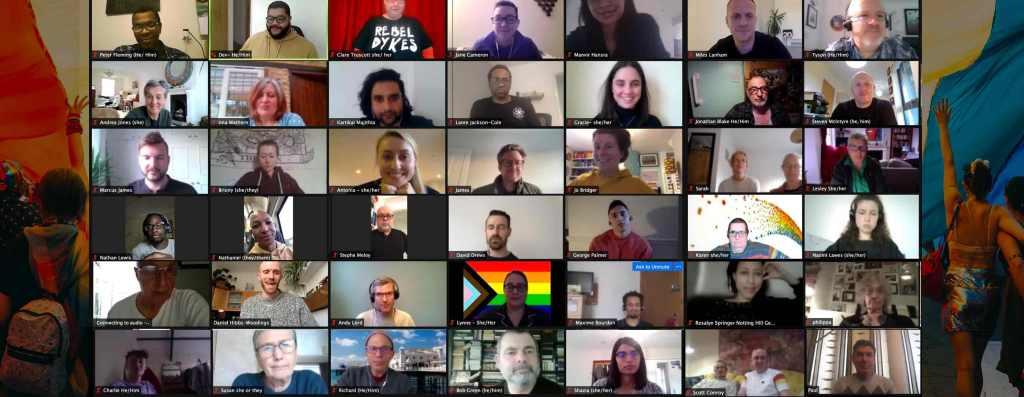
Our welcome event was a massive success, with nearly 100 subscriptions to our mailing list and 60 participants, who all attended to make their voice heard and to listen to our amazing speaker and supporter of the project, Jonathan Blake.
What did we do?
Instead of talking about community-led housing structures and going through complex legal jargon, we wanted to ask the simple questions that really matter to us. We asked the following five questions and split our audience into breakout rooms to discuss them:
1. What are your experiences of accessing housing as an LGBTQ+ person or do you know of anybody who has struggled to access or live in housing because of their sexuality or gender identity?
2. Who in our community do you think is in need of housing and why?
3. Why is LGBTQ+ housing important to you?
4. What does LGBTQ+ housing look like and what makes it different from other forms of housing?
5. How can we ensure what we are providing is what the community actually needs?
We had some lively discussions, with a lot of passion from all sides, and we couldn’t have been happier to have started the conversation.
What did we find?
When asked who in our community might most benefit from LGBTQ+ housing a few key themes came up:
Younger and older people were a focus, with the need for intergenerational housing being also raised as important. For young people, homelessness and housing affordability (inability to purchase at skyrocketing market levels) were noted as reasons for LGBTQ+ housing. For older people, it was finding a supportive community and not being ‘locked out’, and stemmed from a fear of having to go back into the closet when they grew older and needed to enter a specific form of housing (e.g. supported housing). A need for a space where different generations could live side-by-side was raised multiple times by the group.
Trans people were noted to be a group particularly affected, which reflects the statistics on the community which shows a far higher percentage of homelessness within the trans community. Another attendee noted that cultural and religion can play into people’s situations, in that certain groups and religions will face prejudice from their community for their sexuality or gender identity. These kind of environments can affect anyone and this varies massively on an inter-sectional basis. For example, it was noted that those living with parents in the home environment and flatmates in shared living accommodation were often at risk of attack, intimidation and in the worst cases, being made homeless. For shared accommodation it was described as often being a ‘lucky dip’ of whether their next flatmate would be homophobic.
Immigrants, refugees and asylum seekers were recognised as being in need of housing and support, with only a few organisations able to direct these people to safe housing and no specific housing actually owned by an LGBTQ+ organisation for this purpose. People recently released from prison was also mentioned, with higher than normal support needs being a factor in them needing specific and welcoming accommodation.
Gender was also raised, for example women, who also face sexism on top of anti-LGBTQ+ prejudice.
We then asked the group why we need LGBTQ+ spaces.
Affordability was a big concern, with many noting that home ownership was simply out of reach for our community and getting on the property ladder being impossible – this was regarded as an LGBTQ+ specific issue because of the financial disadvantages that many LGBTQ+ people experience compared to the general population (lacking familial support, no strong networks etc). The pandemic was cited as having exacerbated the issue, with many people’s savings wiped out as a result of job losses, furlough etc. Additionally, some participants noted difficulties accessing social housing and a fear of living in it if they were to be allocated a property. For private renters, Section 21 was noted as a justification for homophobic revenge evictions, which could be weaponised against tenants. Some of the participants had either directly experienced or knew of experiences of homophobia and transphobia from private landlords when searching for or during a tenancy.
Current provision of LGBTQ+ inclusive accommodation was even noted to be a risk, with one person saying they had experienced homophobia in an environment which touted itself as ‘gay friendly’.
One group discussed that LGBTQ+ communities often face barriers in coming together in physical spaces. The closure of many LGBTQ+ spaces was mentioned and that many of the remaining ones were not physically accessible to those with disabilities. Many noted the need for physical spaces where residents, the LGBTQ+ community and the local area could meet together in a safe environment. Safety was a key issue which ran throughout the session, with some attendees noting they did not feel safe in their local area and an LGBTQ+ living space could be a place where they could feel secure and safe to be who they are.
One participant noted that an environment was needed where sexuality and gender identity were understood implicitly by both the housing provider and the wider community, to prevent us needing to ‘come out again and again’. This extended to services offered, with some participants mentioning that their landlord or provider did not have any LGBTQ+ services or support available, which would be something an LGBTQ+ housing provider would be better equipped to provide. General providers were noted to have not accepted that LGBTQ+ people do have often different and specific needs.
We then asked the community what LGBTQ+ housing looks like, compared to a generic housing development.
Interestingly, the majority of answers were not physical attributes of a development. One person noted it would be “a place to take your mask off” and “a place to share with your chosen family”. The participants agreed strongly that any spaces should not be LGBTQ+ exclusive, and should instead be cohesive and additive to the local community, not isolated or ghettoised. The consensus was that mutual support, understanding and a shared identity were paramount, and a place where being LGBTQ+ was actively celebrated and where one could be “free of conforming to societal expectations”. One participant said that we should have an agreement to live by a set of values which we develop, based on the notion of inclusivity, acceptance and respect.
Diversity was a key theme (with POC/BME inclusion specifically mentioned), with many noting that we should work with the local community to ensure the rich diversity of London is represented throughout the scheme by eventual residents and service users, and that the design of any properties take local, diverse opinions into account and actively involve a wide mix of people in the co-design process.
In addition, the following themes were mentioned:
– Access to green space
– Affordable housing (the definition of ‘affordable was also brought into question, e.g. is Shared Ownership affordable?)
– Urban environment (some participants felt safer in city environments)
– Intersectional understanding at the heart of the development
– Environmentally friendly in the long term
– Secure and safe
– Physically accessible
– Pride of living regardless of tenure – social housing provision should be celebrated
In terms of physical provision, the element of choice came up multiple times. Some noted that they would live in environments with shared communal facilities, whereas others wanted their own self enclosed space. All participants broadly agreed that a range of accommodation should be offered with shared social spaces to tie the community together. Intergenerationalism was again mentioned here, with some noting that people at different stages of their lives have different physical housing requirements, however all would benefit from shared space and being close to one another.
When asked how we engage with the wider community, participants noted the following as key in ensuring what we provide is what the community actually wants and needs:
– Research on our community and our needs (focus groups, surveys etc)
– Informed data collection
– Working closely with the local area, not just the LGBTQ+ community
– Consultation and conversation with our community and its diverse membership
– Establishing democratic management structures to ensure the project and eventual organisation are truly community-led
These were underpinned by the importance of a continuous feedback loop to keep up with shifts in opinions, requirements, demographic changes etc.
Where to next?
We were blown away by the contributions made by our community at the event, but we recognise that there is far more work to do in further developing this picture.
During our next meeting, scheduled for 4th May 2021, we will recap some of the key themes identified during the session and will begin to further develop our outreach and engagement model. The emphasis on the need for research, data collection, consultation and conversation picked up in the session particularly resonated with us, so we will be working to see how we can develop this further, perhaps into a research study looking to answer these questions more thoroughly.
We are here to listen to your experiences in accessing or living in housing. To share your story with us, please contact us. Every story and experience we hear helps us to create a picture of what we need to provide.
 First Brick Housing